

PHOTO CONTEST
IAPT In Pictures
IAPT Photo Contest 2025 Awardees
We are very happy to announce the IAPT Photo Contest Award Winners! We had three categories and for each one there were prizes for first (US$300), second (US$200), and third places (US$100). We would like to thank all the participants and the reviewers (Category 1: Abubakar Bello, Anna Monro, and Blanca León; Category 2: Lorenzo Peruzzi, Vinita Gowda, and Stephen Boatwright; Category 3: Daniela Zappi, Li Zhang, and Mauricio Bonifacino).

Alpine Sanctity and Survival: Saussurea obvallata thriving in the nival ecosystem of the Western Himalaya
Saussurea obvallata (DC.) Sch.Bip. (Asteraceae) locally known as 'Brahma Kamal' is an iconic sacred alpine herb of the Himalayas that thrives in harsh nival habitats near glacial lakes. This image captures its striking bloom amidst a biodiverse alpine ecosystem shaped by extremes.

Desert Bloom: A Symphony of Namaqualand
Striking view of the Namaqualand landscape. Rugged hills rise in the distance, aloes standing strong, and a sea of golden yellow daisies bursts into life—a vivid celebration of nature’s resilience and beauty in the arid wild.

Sunset watchers of the Aegean…
To glimpse the Aegean sunset through the eyes of a clover (Medicago marina L., Fabaceae), gently bowing to the fading sun as it melts into the sea — a quiet farewell, whispered in golden light.

Someone would say it’s a uterus, but it’s not 😊
Typical crocus (Crocus cf. heuffelianus Herb., Iridaceae) leaf cross-section with a central keel and lateral arms. Crocuses are like an amulet to me, a living reminder of my late mentor, my guru of science. These little buddies have become my safe place in the world of research.

The Art of Reproduction in a Himalayan Cobra Lily: Unveiling Sexual Dimorphism in Arisaema propinquum
A high-resolution macro image showing the sexually dimorphic spadices of Arisaema propinquum Schott (Araceae). The left spadix bears densely packed male flowers, while the right displays distinctive black-tipped female flowers, highlighting reproductive specialization.

Wedges of Nature
Cross-section of Dolichandra unguis-cati (L.) L.G.Lohmann (Bignoniaceae) stem revealing the striking radial architecture of phloem wedges dissecting the xylem, an anatomical hallmark exclusive to the genus. A unique blend of developmental complexity and geometric beauty in Bignonieae.
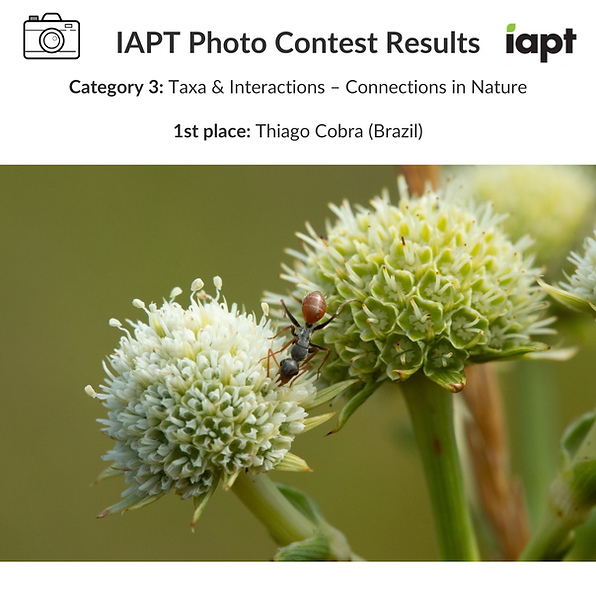
An unexpected acrobatic pollinator
At the fragmented southern edge of the Brazilian Cerrado savannas, an ant balances between the capitula of Eryngium juncifolium (Urb.) Mathias & Constance (Apiaceae). When it inserts its head into the flower for its nectar, it is baptized by the flower's gynoecium.

Hold it tight!
A male carpenter bee forces its way through the pink petals of an Andira flower [Andira fraxinifolia Benth. (Fabaceae)], trying to reach its sweet reward. Although it seems to struggle to hold onto the flower — even with one leg behind the banner — the reward appears to be worth the effort.

Do Not Disturb
A male Eucera bee finds shelter for the night inside a Papaver rhoeas L. (Papaveraceae) flower. Beyond pollination, this image captures a more intimate interaction—rest, refuge, and rhythm in nature’s daily cycle.